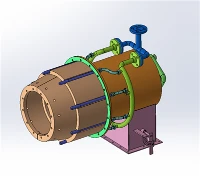
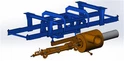
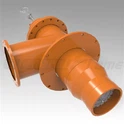
Selective Non‑Catalytic Reduction (SNCR) is a core flue‑gas denitrification technology from Jiangsu Jufeng. It operates without any catalyst, relying solely on the high‑temperature kiln environment. An amino‑based reductant (urea or aqueous ammonia) is injected into a precise temperature window to selectively reduce NOₓ in the flue gas into harmless nitrogen, water vapour, and a small amount of CO₂. The "selective" nature ensures the reductant preferentially reacts with NOₓ, minimising side reactions with oxygen.
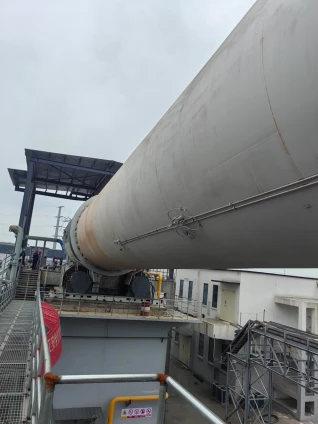
The application of SNCR on a rotating rotary kiln
1.Reaction Mechanism (with urea as the reductant)
The process follows four consecutive stages after injection:
atomisation & evaporation → urea pyrolysis (to HNCO and NH₃) → free‑radical generation (forming NH₂ radicals) → NOₓ reduction (NH₂ converts NOₓ to N₂ and H₂O). Each stage is critical and requires precise control of temperature and flow conditions.
2.Key Technical Advantages
- Optimal temperature window – controlled at 900–1150°C, where the reduction rate peaks and denitrification efficiency is maximised.
- Sufficient residence time – the entire sequence (evaporation, decomposition, reaction) takes at least 0.5 seconds, ensuring complete conversion.
- Superior atomisation and mixing – compressed air breaks urea solution into micron‑sized droplets, spreading uniformly across the entire furnace cross‑section.
- Economical NSR control – the ammonia‑to‑NOₓ molar ratio (NSR) is stabilised in the 1.25–1.5 range, balancing emission compliance with low operating costs.
Summary
Jiangsu Jufeng's mature SNCR technology offers a reliable, cost‑effective, and catalyst‑free solution for industrial kiln NOₓ abatement, backed by rigorous reaction engineering and field‑proven performance.
– Jiangsu Jufeng – Clean Combustion & Flue‑Gas Purification.