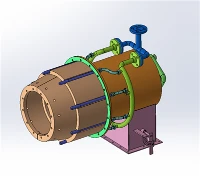
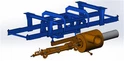
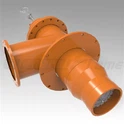
Most of the burners of the rotary kiln pass through the kiln cover and extend into the kiln head cylinder to heat the material to the required temperature by flame and radiation. Burners include coal injection pipes, oil spray guns, gas nozzles, etc., depending on the type of combustion. When the reaction temperature is low, a combustion chamber is placed beside the kiln head cover to supply hot flue gas into the kiln to supply heat. In the early rotary kiln, the burner was mostly constructed with a single air duct. The primary air volume accounted for 20% to 30% of the total combustion air volume, and the primary wind speed was 40 to 70 m/s. Its function is mainly to transport coal powder, and to mix coal and wind. The secondary air suction effect is very small, and the flame is also inconvenient to adjust, which is difficult to meet the production requirements. With the development of pre-decomposition technology and the increasingly demanding requirements for the use of low-activity fuels and environmental protection, burner technology has also made new progress. Various manufacturers have adopted multi-duct burners, and multi-duct burners have the following functions;
(1) Increasing the mixing of pulverized coal and combustion air, increasing the burning rate, and completely burning the fuel.
(2) Increasing the adjustment means for the air volume and wind speed of each channel, making the flame shape and temperature adjustment flexible and convenient, suitable for clinker calcination.
(3) The burner has a long service life.
(4) Protect the lining material in the kiln and extend the service life of the lining.
(5) Stabilize clinker quality and increase system output.
(6) The structure is simple, the maintenance and replacement are convenient, and the system running time is reduced due to the burner failure.
(7) Minimize the amount of primary air, increase the utilization of high temperature secondary air, and improve the utilization rate of clinker recovery heat.