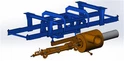
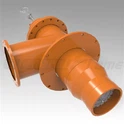
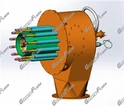
First, pulverized coal combustion can be divided into three stages: preparation stage, combustion stage and burnout stage.
1. The preparation stage includes fuel drying, coal preheating, carbonization, water vaporization, coal temperature above 100℃, physical water escape, and the end of drying. Continue heating to a point where it begins to break down, releasing the volatiles and leaving the solid coke, a process called distillation. The more volatile matter, the lower the temperature needed to release it, and vice versa. Lignite is about 130 ° c and anthracite about 400 ° c, with bituminous coal somewhere in between. Pulverized coal in the preparation stage, because the combustion has not begun, basically do not need air, is a heat absorption process.
2. The combustion stage includes the combustion of volatiles, which are mainly hydrocarbons, and coke. The volatiles reach a certain temperature and concentration before burning in coke. In general, the temperature of volatile combustion is generally considered to be the ignition temperature of pulverized coal. High fuel volatility, low ignition temperature, and vice versa. Coke combustion is the main combustion of pulverized coal, and the added heat of coke generally accounts for more than half of the total calorific value. It is the main heat source in pulverized coal combustion. Coke takes much longer to burn than volatile matter. Because coke combustion is not uniform, complete combustion is more difficult than volatile matter. How to improve coke combustion rate and burnout rate is an important part of coke combustion.
3, combustion stage (or ash formation stage) will scorch coke, coke shell to form a layer of ash, it is difficult to participate in the mixing of combustion air, so as to slow down the combustion, especially high ash coal is more difficult to burn. At this stage, the heat is small and the amount of air required is small, but it must be kept hot and given time.
When pulverized coal is burned, its combustion characteristics, heating area per unit area and specific surface area are greatly increased. When the density of coal is 1000kg/m3, the surface area of 1kg coal particle size varies. When the average particle size of pulverized coal is very small, the surface area per unit mass is very large, the relative velocity between pulverized coal and airflow is very small, and the pulverized coal particles are suspended in the air. When pulverized coal is fed into the rotary kiln by the burner, it is suspended in the rotary kiln space. Pulverized coal must be heated to a certain temperature before it can catch fire. The ignition temperature is related to the temperature of volatiles that begin to precipitate out after the coal powder is heated, that is, the lower the temperature, the easier the ignition. When anthracite and anthracite are burned, the volatile content of the coal is high, the volatile content starts to be low temperature, easy to fire, fire, flame will flow in the opposite direction with a certain speed, if the speed is equal to the coal burner from a certain place, then the flame is stable. Instead, the flame is blown downstream and becomes stable as the airflow slows to a certain speed, which can lead to flame explosions and flame instability. A quick flame burns out. The stable combustion of pulverized coal in time is an important condition for the safe and economical operation of burners. The pulverized coal airflow generally does not exceed 500mm from the 200 distance of the burner to 300mm.When pulverized coal air is injected into the kiln, convection heat transfer occurs between the high-temperature flue gas and the two winds. In addition, the heat transfer of hot gases is also radiated. Through these two ways of heat exchange, the air temperature of pulverized coal rises rapidly. When the temperature reaches a certain number, the coal starts to burn. Industrial control of the ignition process: 1, reduce the fineness of pulverized coal;2. Reduce air volume;3. Increase the ability of pulverized coal air to absorb high-temperature flue gas. For the complete combustion of pulverized coal, the flame must ensure sufficient length, that is, in the rotary kiln pulverized coal fly, pulverized coal in the kiln for 0.3 ~ 0.5m fire at 1-2 m, most of the volatile matter has been precipitation, the remaining coke particles tend to 10 ~ 30m (with different types of kilns).A kiln that burns completely or almost completely at different speeds. The position of burner of rotary kiln is divided into temporary stop station and maintenance position. Rotary kiln burner location: because of high temperature, cannot enter the kiln, can only use the lead vertical location method. Methods: upper burner tube all leave; Then back to the burner end to the outside of the kiln burner end through a vertical line of the central hole, and the ground vertical distance; Good burner, according to the ground plumb line to record the distance point, adjust the new burner position; Install duct and burner in normal position. Determination of the position of the burner after the burner: the position of the burner center on the kiln head cover is its foundation. Before determining the relative position of burner and kiln, first determine the coordinate position of burner end face of kiln mouth, and then determine the intersection point between burner center and kiln and the coordinate of kiln center through "light point". Theory and practice have proved that the piero center of the burner center is located at the lower right of the kiln mouth, that is, the fourth quadrant (counterclockwise rotation of the kiln) is slightly lower than the kiln center and the layer. You can also use the rotation Settings method. In the drying process of rotary kiln burner, it shall try its best to ensure complete combustion under the condition of complete excess air coefficient, and the emissions of CO and NO2 shall be reduced to the minimum, the flame shape is thin and long, and the air volume to keep the flame stable as little as possible under abnormal kiln conditions.