With the continuous improvement of environmental protection requirements, the requirements of NOX emission of cement production enterprises are also increasing.Since March 2014, the NOX emission requirement of new cement enterprises is less than 400mg/m3, and the NOX emission concentration in key areas is lower than 300mg/m3.NOX control technologies commonly used at present include: optimizing the combustion system of the kiln and the decomposition furnace, changing the burden scheme and mixing the mineralizing agent, reducing the temperature and time of the clinker burning, improving the flammability, adopting the low NOX burner, and implementing the fractional combustion technology in the kiln tail preheater and pipeline.But they do not reduce environmental requirements.At present, cement enterprises generally adopt "low nitrogen denitrification".Non-catalytic reduction of "SNCR" denitrification process controls nitrogen oxide emissions.The denitrification process of SNCR is mainly spraying ammonia water in the preheater or decomposition furnace, which is reduced to nitrogen through reaction with nitrogen oxide.
"SCR flue gas denitrifying reducing agent gasification/mixing integration device for cement kiln" sprays the SCR denitrifying reducing agent to u. s. a part of the preheater at the end of cement kiln utilizes the ascending flue through the reducing agent injection device.Cement kiln tail high temperature flue gas about 500 ~ 750℃, reducing agent gasification into gas ammonia.The gas ammonia is mixed with the high-temperature flue gas and then enters the cyclone separator.The swirl effect of cyclone is used to enhance the gas disturbance and make the gas and reducing agent mix well.After passing through the outlet flue of the preheater, the reducing agent enters the SCR denitrification device installed downstream for the denitrification reaction.This technology is a method and device for integrated gasification mixing of cement kiln SCR denitrifying reducing agent with low investment and operation cost, low energy consumption, high safety and reliability.In the existing technology, ammonia spray covers a small area and its denitrification efficiency is not high.
In order to overcome the shortcomings of existing technology, our company provides a kind of nitrogen-reducing ammonia spraying device for rotary kiln preheater in cement factory.To solve the problem of low nitrogen removal efficiency after ammonia spraying.Ammonia water is injected into the riser flue of preheater cyclone separator, NOX is reduced to nitrogen, and ammonia water is more effective in the riser flue of preheater cyclone separator.Maximize coverage to reduce NOX emissions, thereby further reducing NOX emissions.Through the following technical solutions:
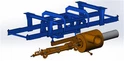
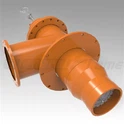
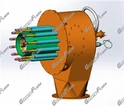
The utility model relates to a nitrogen-reducing ammonia spraying device of rotary kiln preheater in cement factory, including cyclone separator and several ammonia spray guns.Its characteristic is that there are several ammonia spray guns uniformly arranged in the rising flue of cyclone separator. The nozzle of ammonia spray gun extends to the rising flue of cyclone separator, and the nozzle of ammonia spray gun is set downward. The height of ammonia spray gun is 1-1.5m from the rising flue of cyclone separator.The back end of the ammonia spray gun is provided with an ammonia inlet and an air inlet, and the front end of the ammonia spray gun extends to one end of the rising flue of the cyclone tube and is provided with a protective cover.The protective cover is made of high temperature resistant, corrosion resistant and wear-resistant materials.
The number of ammonia spray guns is 4-8, distributed evenly along the outer circumference of the rising flue of the cyclone.
Compared with the existing technology, the effect of this technology is as follows:
There are four or six ammonia spray guns evenly arranged in the rising flue of the preheater cyclone separator, but they are not installed in the decomposition furnace.The reason is that the dust concentration in the rising flue of cyclone separator is lower than that in the decomposing furnace, which reduces the influence of dust particles on ammonia adsorption and improves the reaction efficiency of ammonia and nitrogen oxides.The reaction temperature is about 800 ~ 1100℃, so AM is appropriate.