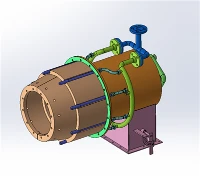
A flame detector detects the generation of smoke and the release of heat while the substance is burning, and also produces invisible light radiation that is visible or not in the atmosphere.
Flame detectors, also known as photosensitive fire detectors, are fire detectors that respond to fire, that is, a fire detector that detects the intensity of the flame and the flashing frequency of the flame.
According to the light characteristics of the flame, there are three types of flame detectors: one is an ultraviolet detector sensitive to the shorter wavelength ultraviolet radiation in the flame; the other is an infrared sensitive to the longer wavelength infrared radiation in the flame. The detector; the third is an ultraviolet/infrared hybrid detector that simultaneously detects short-wavelength ultraviolet rays and long-wavelength infrared rays in the flame.
According to the detection band, it can be divided into: single ultraviolet, single infrared, double infrared, triple infrared, infrared/ultraviolet, additional video and other flame detectors.
According to the type of explosion-proof, it can be divided into: explosion-proof type, intrinsically safe type.
For the ultraviolet light of 0.185~0.260 micron wavelength generated in flame combustion, a solid substance can be used as a sensitive component, such as silicon carbide or aluminum nitrate, or an inflatable tube can be used as a sensitive component, such as a Geiger-Millet tube.
For the infrared light of 2.5~3 micron wavelength generated in the flame, the sensor of aluminum sulfide material can be used. For the infrared light of 4.4~4.6 micron wavelength generated by the flame, the sensor of lead selenide material or aluminum niobate material can be used. Different sensors can be selected according to the spectrum of different fuel combustion emissions, and triple infrared (IR3) is widely used.
1. The general principle is to install the detector at twice the height of the highest target in the protected area. Within the effective range of the detector, it cannot be blocked by obstructions, including transparent materials such as glass and other spacers. It can cover all targets and areas that need protection, and is convenient for regular maintenance.
2. When the detector is installed, it is generally inclined downward by 30-45° angle, which can look down and look forward, and at the same time reduce the possibility of contamination of the mirror surface. Straight incidence should be maintained for each possible fire in the protected area to avoid indirect incidence and reflection.
3. In order to avoid detecting dead zones, another flame detector is usually installed in the opposite corner, and it can also be used in case of failure of one of the flame detectors.
The previous points are generally considered when the flame detector is installed. Here, you should pay special attention to avoiding possible false alarm sources within the cone detection range of the flame detector.