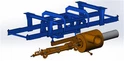
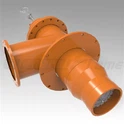
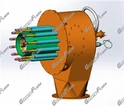
Low-nitrogen burners, by adjusting the combustion air and the combustion head, can obtain the best combustion parameters.
Single-stage fire, two-stage fire, two-stage fire progressive/proportional adjustment
Can adapt to any type of combustion chamber.
Air and gas are mixed in the combustion head.
The optimum combustion parameters can be obtained by adjusting the combustion air and the burner head.
The mixer can be removed directly without removing the burner from the boiler, making it easy to maintain.
Use servo motor to adjust the first and second air flow, and when
When the burner is stopped, the damper is closed to reduce heat loss in the furnace.
A valve seal control can be added to the valve block.
It is fixed to the boiler with a flange and an insulating sealing ring; it is equipped with a 4-hole and 7-hole coupling.
A blast tube that is larger than the standard length is available upon request.
One is to use the pressure head of the combustion air to suck back part of the combustion flue gas, enter the burner, and mix and burn with the air. Due to the recirculation of the flue gas, the heat capacity of the combustion flue gas is large, the combustion temperature is lowered, and NOx is reduced.
Another type of self-recirculating burner is to directly recycle some of the flue gas into the burner and to join the combustion process, which has the dual effects of suppressing nitrogen oxides and energy saving.
The principle is that some of the fuel is burnt intensively, and the other part of the fuel is lightly burned, but the overall amount of air remains unchanged. Since both parts are burned at a deviation from the stoichiometric ratio, NOx is very low, and this combustion is also called off-burn or non-stoichiometric combustion.